
I one asked a historian friend what he thought the “Again” referred to in “MAGA.” He replied, “It means they want to be children again, opening up presents in the living room.”
Good point. I want that, too. But I also know that it was not perfect—that there was addiction, that we wanted money, that chronic violence in our suburban neighborhood made my childhood precarious. Even if given that wish, I do not want to go back. What’s more, I don’t turn such nostalgia into an ideology, and I certainly don’t blame other people for the passing of such a Golden Age.
Which brings us to Donald Trump’s recent press conference about crime, homelessness, and dirt in Washington, D.C. It’s rather long, and it frequently goes off topic, but here’s the tell-tale quote:
“We’re going to restore the city back to the gleaming capital that everybody wants it to be.”
Yeah, about that…
Is crime in Washington an “emergency”? Was the capital ever a “gleaming capital,” free from crime, vagrancy, and dirt? The short answer, of course, is…no.
The early days of the city are chronicled by Margaret Leach in her wonderful book, Reveille in Washington: 1860-1865, published in 1941.
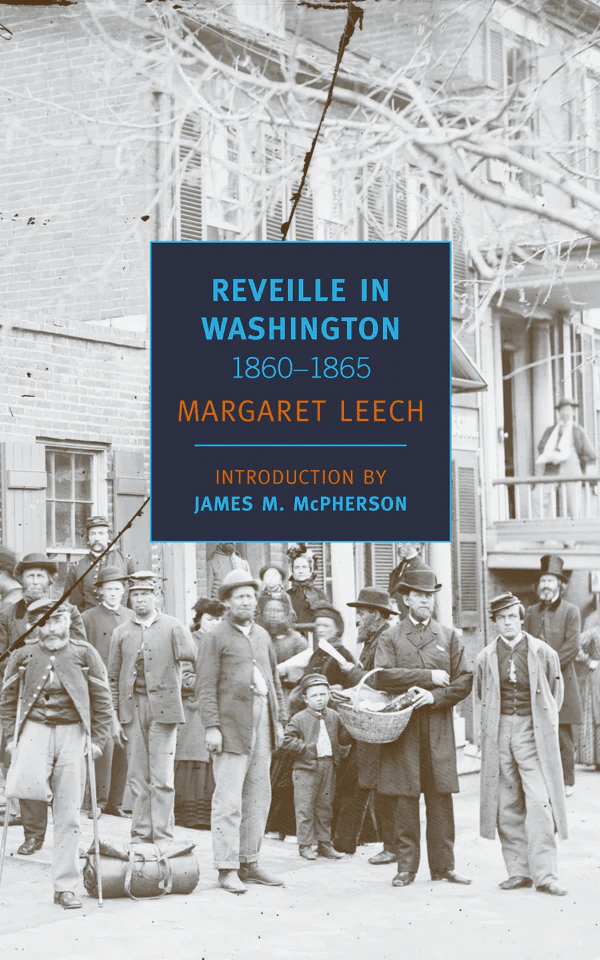
According to James M. McPherson, in the book’s Introduction,
Washington was built on a swamp, with open drainage canals carrying putrid offal to the river within sight (and smell) of the White House. Pigs rooted for garbage in the mostly unpaved streets that were, according to season, shin-deep in mud or dust. Unsightly groups of shacks and backyard privies clustered along many of the streets. Washington was “a hydrocephalous hamlet,” wrote the caustic correspondent of the London Daily Telegraph, a “great, scrambling, slack-baked embryo of a city basking in the December sun like an alligator on the mud-bank of a bayou in July.
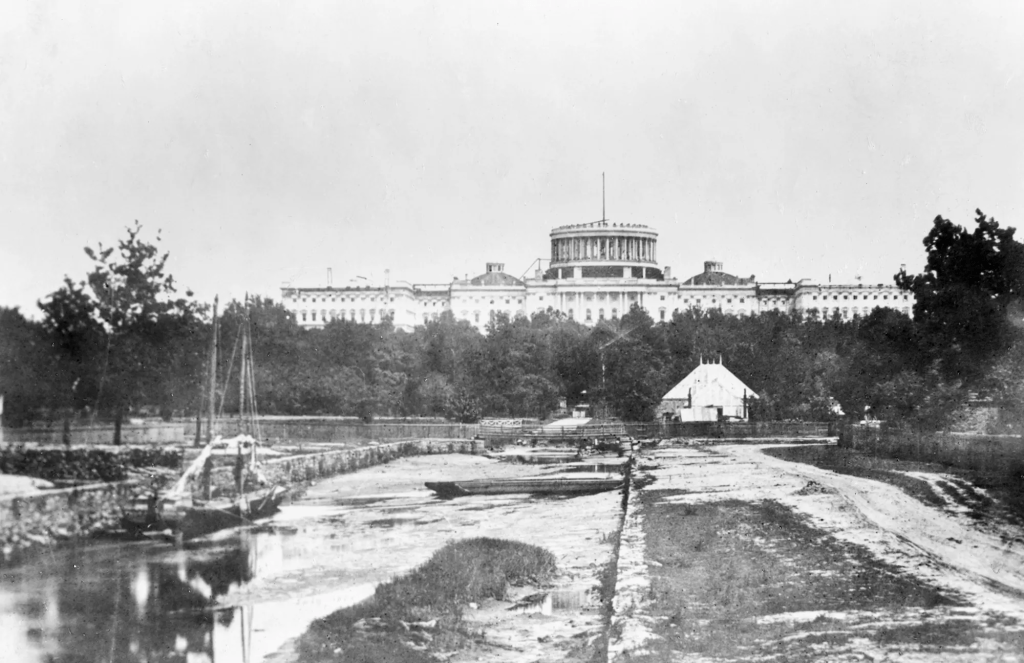
To make matters worse, McPherson writes, the “massive influx” of soldiers during the Civil War
brought with it an unsavory task force of prostitutes, gamblers, and liquor vendors from near and far; not until 1863 did an aroused citizenry and military police mount a counterattack against this irruption of vice. The huge expansion of the civil service necessary to mobilize the war effort brought a housing crisis that initially multiplied the jerry-built, ramshackle residential districts. The advance of Union armies into slave territory thrust a backwash of “contrabands” (escaped slaves) into Washington’s already overcrowded black neighborhoods.
Leach dedicates an entire chapter—”Winter of Security”—to the problem of crime in the city. The most recurrent kinds of crime were violence, drunkenness, and prostitution.
On scrofulous hillsides in the Northern Liberties and in a scramble of mean passages on the Island, whites and blacks had opened a multitude of resorts…Fighting and Tincup Alleys welcomed teamsters and laborers and the riffraff of the volunteers to hovels where pleasure was dispensed in bare and dirty rooms, sometimes the abode of families with small children. Soldiers were often robbed of their pay, or pawned their uniforms and blankets to pay for drink. The poisonous tanglefoot whisky, illicitly dispensed, led to brawls, shootings, stabbings and riots. Most of the crimes for which soldiers were arraigned were committed in the dives of Washington.
The crime and squalor were also no stranger to the “finer” sections of town:
In the expensive resorts, there were luxurious furnishings, and the pretty young hostesses were dressed in silk. One fashionable establishment maintained a summer place at Great Falls, twelve miles up the Potomac, as a retreat for the personnel when business was dull. Yet the red-plush houses had many resemblances to the cheap and barren dives. The privy at Sal Austin’s, like many another in the Northern Liberties and on the Island, gave up the body of a newborn infant. Whisky was illicitly sold. Drunken men grew rough and excited. Pistol shots rang on the midnight air, and frightened girls bawled from the windows for the police. A roundsman was stabbed in Marble Alley.
The city was also no stranger to one of Donal Trump’s most popular bugbears: roving gangs of teenaged hoodlums.
[T]he district had no adequate prisons…Pending their trial, Washington had no suitable place in which to lodge the members of its own youthful gang of robbers, the Forty Thieves, or the runaway boys and delinquent girls who came trailing after the soldiers.
What the soldiers broughteth, they could also take away—or so the residents thought. “Washington welcomed military protection,” Leach writes, “and arbitrary methods of handling crime were accepted as a necessary part of the wartime emergency.” Unfortunately—and unsurprisingly—it didn’t work. Crime, “gambling hells,” and “bawdy houses” continued to flourish.
What Donald Trump is doing in Washington is not going to affect the crime rate, and it’s certainly not going to “restore” the city to a condition that never existed in the first place. It’s not meant to. Nostalgia is no longer just a fantasy—it’s a Political Manifesto.

 the wrong font
Leave a comment