
“Now and then the haze of the dead years thins out and shows us a few of these young men and we are left with long thoughts.”
–Bruce Catton, Gettysburg: The Final Fury
We are often exhorted, when encountering problematic words and actions from people in the 19th Century, to keep in mind the adage from novelist L.P. Hartley, “The past is a foreign country; they do things differently there.” Max Longley, for instance, in his review of Jonathan W. White’s A House Built by Slaves: African American Visitors to the Lincoln White House, at Emerging Civil War, writes, “Professor White, when confronting one of Lincoln’s racist prewar public statements, calls Lincoln ‘a man of his times.’” Fair enough.
What happens to this temporal distancing, though, when we come across someone who is not just “a man of his times” but also, apparently, of ours?
John W. Haley (1840-1921) served in Company I of the 17th Maine, from August of 1862 until the end of the War. His journals, painstakingly edited by Ruth L. Silliker, were published in 1985 under the title, The Rebel Yell & the Yankee Hurrah: The Civil War Journal of a Maine Volunteer.
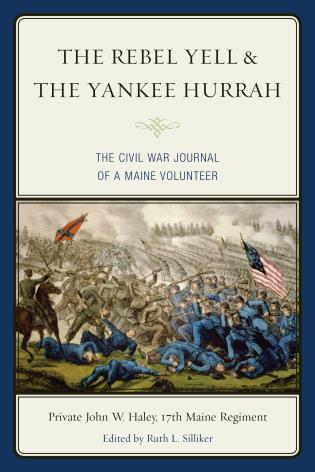
In the book’s Preface, Silliker offers the familiar exhortation:
Regrettably, one of the widespread nineteenth-century social attitudes Haley mirrors is a disdain for the Irish and Negroes…and his journal treats the subject by expressing the feelings of the soldiers at the time of the war. I have kept theses passages in the text and trust that today’s reader will understand the context in which the offensive phrases were originally written.
Part of that context is what happened to abstract ideas of freedom once Northern soldiers had to actually rub elbows with those whom they were supposed to be liberating. In his entry for October 1st, 1864, for instance, describing an attack on “colored troops” outside Petersburg, VA, Haley writes:
I desire that their freedom should be established but don’t consider that freedom involves social equality. If to them it means the liberty to foist themselves on our society, it also means to us the liberty to decline to entertain them. They might be just as good, just as clean, just as intelligent, and possess all the qualities of gentlemen, but they are different species of bird.
Nothing too surprising there. Two years earlier, Abraham Lincoln had expressed a similar opinion on such “foisting” when he told a delegation of Black leaders visiting the White House, “You and we are different races. We have between us a broader difference than exists between almost any other two races…We should be separated.”
What is surprising, though, is how Haley follows up his diary entry:
I have to acknowledge that my principal reason for disliking them is jealousy. [Sic] The colored troops have been much favored of late, and we have been contemptibly ignored, hence my feelings are not especially fraternal. If a division of white troops had been favored thus, I would be equally indignant and just as outspoken about it. This resentment is widespread.
This particular commentary—indeed, this “metacommentary”—is immediate and impulsive, a reflexive examination of one’s own prejudices that is so unlike any of the Civil War diaries I’ve read that my initial reaction was, “Wow! Haley was ‘woke‘!!”
But was Haley “ahead of his time” in this regard? It’s hard to say. Certainly, many of his contemporaries expressed “progressive” opinions, such as can be found in As If It Were Glory: Robert Beecham’s Civil War from The Iron Brigade to the Black Regiments.

Also, Lincoln’s views on social equality evolved over time. Longley writes:
In his final speech – in a passage which angered a listening John Wilkes Booth – Lincoln suggested that some black people should vote, showing that he’d changed considerably from his insulting leave-America remarks in August 1862.
Another aspect of Haley’s diary that puts him squarely “in context” for his time period are other, more troubling entries, as Silliker warned us about. In an entry dated May 6, 1865, e.g., he writes, while just outside Richmond:
A host of young n*****s followed us to camp and soon made themselves too familiar. We bounced them up in blankets and made them butt against each other—also against some pork barrels. One young n****r had an arm broke, and several others were more or less mistreated.
Only he didn’t use asterisks and there is no commentary, “meta-” or otherwise. (It’s possible he meant to condemn the incident simply by presenting it.)
Silliker, in her Preface to The Rebel Yell & the Yankee Hurrah, says that it is only about two-thirds as long as Haley’s original journal, with a lot of “lengthy asides” being sacrificed for the sake of the narrative. Thus, the only way to get a better handle on Haley’s sensibilities would be to make a (not unpleasant) visit to the library in Saco, Maine that holds his original pages.
Maybe, though, the question needs to be reversed. Not, “Was Haley ahead of his time?,” but, “To what extent are we still living in his?” After all, the resentment he expressed regarding the perceived favorable treatment of “colored troops” is hardly a thing of the past. In a 2019 article titled, “Understanding the Role of Racism in Contemporary US Public Opinion,” Katherine Cramer, of the University of Wisconsin, writes:
In the past several decades, the dominant measure of symbolic racism in political science has been the racial resentment scale, developed for the American National Election Study (ANES) in the mid-1980s by Kinder & Sanders (1996).[i]
And a 2014 study by Clara L. Wilkins and Cheryl R. Kaiser, in the journal, Psychological Science, revealed that “some Whites respond to racial progress by seeing themselves as victims of discrimination.”[ii]
Likewise, the aversion Haley had to having certain people “foist” their society on him, and Lincoln’s early insistence on racial separation, are still in effect in 2024, at least insofar as such attitudes shaped our current segregated landscape. One of the 1920’s neighborhoods in the suburb where I live, for instance, had, at least up until 2020, a covenant on their deeds saying, “No lot or dwelling shall be sold to or occupied by a colored person.” If the past really is a “foreign country,” its border appears to be encroaching on my own driveway.
In any case, reading Haley’s exceptional diary gives rise to “long thoughts” about our fascination with the Civil War and our feelings of kinship with those who lived it; the 1860’s are a country far away enough to be foreign, yet close enough to seem like home. No doubt the extraordinary number of photographs from that era contributes to such a feeling. But so, too, does the rhetoric of people like Haley—whether we see him as a foil or as a reflection in our own mirror.
[i] Catherine Kramer. “Understanding the Role of Racism in Contemporary US Public Opinion.” Annual Review of Political Science, 2020. 23:153–69.
[ii] Clara L. Wilkins and Cheryl R. Kaiser. “Racial Progress as Threat to the Status Hierarchy: Implications for Perceptions of Anti-White Bias.” Psychological Science, 2014, Vol. 25(2) 439– 446.

 the wrong font
Leave a comment